Dr. Sameer Chepurwar | Orthopedic & Joint Replacement Surgeon In Chandrapur

Robotic Knee Replacement in Chandrapur for Advanced Knee Care
If you are searching for Robotic Knee Replacement in Chandrapur, Shri Sai Gajanan Hospital | Dr. Chepurwar Orthopedic & Physiotherapy Center provides advanced orthopedic and knee replacement care under the guidance of Dr. Sameer Chepurwar, an experienced orthopedic surgeon with more than 28 years of experience. Knee replacement can help appropriately selected patients who experience severe pain, advanced arthritis, joint damage, deformity, or significant difficulty with everyday movement. Moreover, modern knee replacement techniques focus on accurate planning, appropriate implant positioning, joint alignment, and personalized rehabilitation.
Robotic-assisted knee replacement represents an advancement in surgical planning and precision. Depending on the patient’s condition, anatomy, and treatment requirements, technology-assisted techniques can support the surgeon during knee replacement. However, the decision to use a robotic system depends on the individual case and the technology available at the treating center.
What Is Robotic Knee Replacement?
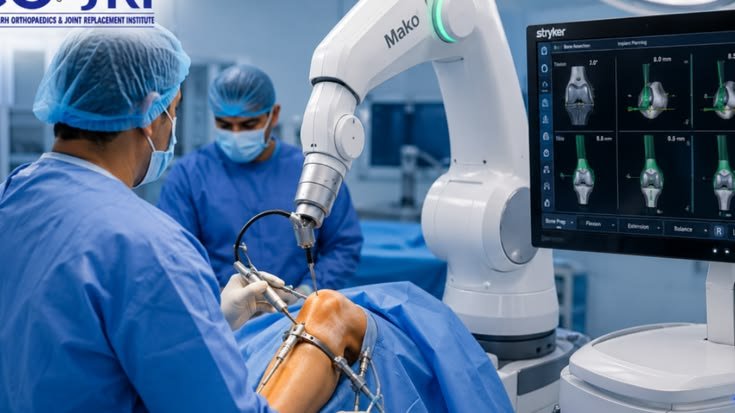
Robotic knee replacement is a technology-assisted approach to knee replacement surgery. It combines the expertise of an orthopedic surgeon with computer-assisted planning and, where applicable, a robotic surgical platform.
During the treatment process, the surgeon evaluates the patient’s knee, studies diagnostic images, and plans the procedure according to the patient’s anatomy. A technology-assisted system may then help the surgeon execute the planned bone preparation and implant positioning with greater control.
However, the robot does not independently perform the surgery. The orthopedic surgeon remains responsible for the procedure, surgical decisions, implant selection, and patient safety.
Therefore, patients should understand that robotic assistance is a surgical tool rather than a replacement for the expertise of an orthopedic surgeon.
Furthermore, not every patient requires robotic-assisted surgery. The surgeon determines the most suitable technique after evaluating the severity of arthritis, deformity, bone condition, previous surgery, age, activity level, and overall health.
Why Is Robotic-Assisted Knee Replacement Considered?
Traditional knee replacement has already become a well-established treatment for severe knee arthritis and joint damage. However, technology-assisted techniques can provide additional tools for surgical planning and execution.
Depending on the system and procedure, robotic assistance may help the surgeon with:
- Preoperative planning
- Assessment of knee alignment
- Bone preparation
- Implant positioning
- Soft-tissue balancing
- Surgical precision
- Individualized operative planning
Consequently, robotic assistance may help surgeons achieve the planned alignment and positioning more consistently in appropriate cases.
Nevertheless, the overall result depends on several factors. These include the patient’s condition, surgeon’s expertise, implant quality, surgical technique, rehabilitation, and adherence to postoperative instructions.
Therefore, patients should evaluate the complete treatment approach rather than choosing a procedure solely because it uses robotic technology.
Who May Need Knee Replacement Surgery?
Knee replacement may benefit patients with advanced joint damage that significantly affects their quality of life.
Common symptoms include persistent knee pain, stiffness, swelling, reduced movement, difficulty walking, and difficulty climbing stairs. Some patients may also experience pain at rest or during sleep.
Common conditions associated with knee replacement include:
- Advanced osteoarthritis
- Rheumatoid arthritis
- Post-traumatic arthritis
- Degenerative joint disease
- Severe cartilage damage
- Knee deformities
- Advanced joint wear
- Certain severe knee injuries
- Failed previous knee surgery
Shri Sai Gajanan Hospital lists these and other conditions among the problems treated through knee replacement surgery.
However, having knee pain does not automatically mean that you need surgery.
Initially, an orthopedic specialist may recommend conservative treatment such as medication, physiotherapy, lifestyle modification, weight management, or other appropriate measures. When these options no longer provide adequate relief and joint damage significantly affects daily life, knee replacement may become an appropriate consideration.
Symptoms That May Indicate Advanced Knee Damage
Knee arthritis often develops gradually. Initially, patients may notice discomfort after prolonged walking or physical activity. However, symptoms can become more frequent as joint damage progresses.
You may need an orthopedic evaluation if you experience:
- Persistent knee pain
- Pain while walking
- Pain while climbing stairs
- Difficulty standing after sitting
- Knee stiffness
- Swelling
- Reduced knee movement
- Grinding or clicking sensations
- Knee instability
- Reduced walking distance
- Pain during rest
- Night pain
- Difficulty performing daily activities
- Visible knee deformity
Furthermore, symptoms can vary between patients. Therefore, a professional examination remains essential.
At Shri Sai Gajanan Hospital, the orthopedic team evaluates the patient’s symptoms and condition before recommending knee replacement.
Robotic Knee Replacement vs Conventional Knee Replacement
Both conventional and robotic-assisted knee replacement aim to relieve pain and restore useful knee function. However, the surgical planning and technology involved can differ.
In conventional knee replacement, the surgeon uses established surgical techniques and instruments to prepare the knee and position the implants.
In robotic-assisted surgery, the surgeon may use computer-assisted planning and a robotic platform to support specific parts of the procedure.
However, the robotic system does not replace the surgeon’s judgment. Instead, it provides additional technological assistance.
Therefore, patients should discuss the benefits, limitations, suitability, cost, and availability of robotic-assisted surgery with their orthopedic surgeon.
The most appropriate technique depends on the patient’s anatomy, joint damage, medical history, surgical requirements, and the surgeon’s assessment.
Benefits of Robotic-Assisted Knee Replacement
Robotic-assisted knee replacement may offer several potential advantages in appropriately selected cases.
Personalized Surgical Planning
Technology-assisted planning can allow the surgeon to create a procedure based on the patient’s individual knee anatomy.
Greater Surgical Guidance
A robotic platform can provide the surgeon with additional information and guidance during specific parts of the operation.
Implant Positioning
Accurate implant positioning plays an important role in knee replacement. Technology-assisted systems may help the surgeon achieve the planned positioning.
Alignment Assessment
Knee alignment is an important consideration during replacement surgery. Computer-assisted planning can help the surgical team assess alignment during the procedure.
Individualized Treatment
Every knee has different anatomy. Therefore, technology-assisted planning can support a more individualized approach when clinically appropriate.
However, patients should understand that results vary. Robotic assistance does not guarantee a specific outcome, and the surgeon’s experience and postoperative rehabilitation remain important.
Knee Replacement Surgeon in Chandrapur
Choosing an experienced orthopedic surgeon is one of the most important steps when considering knee replacement surgery.
Dr. Sameer Chepurwar is an orthopedic surgeon practicing in Chandrapur. His official profile states that he has more than 28 years of experience and specializes in joint replacement surgery, arthroscopic surgery, trauma care, fracture management, and sports injury treatment.
His approach focuses on patient-centered orthopedic care, individualized treatment planning, rehabilitation, and long-term musculoskeletal health.
Furthermore, the hospital provides physiotherapy and rehabilitation through Dr. Shweta Chepurwar, who has more than 15 years of experience in rehabilitation and physiotherapy care.
Therefore, patients can receive orthopedic consultation and rehabilitation support through the same healthcare center.
Diagnosis Before Knee Replacement
Before recommending knee replacement, an orthopedic surgeon performs a detailed evaluation.
The assessment may include:
- Medical history
- Physical examination
- Evaluation of knee movement
- Assessment of pain
- Evaluation of joint stability
- Knee X-rays
- MRI when required
- Blood investigations
- General health assessment
- Pre-anesthetic evaluation
The hospital’s knee replacement information states that a comprehensive assessment may include medical history, physical examination, gait analysis, X-rays, MRI when required, blood investigations, bone-quality assessment, cardiac fitness evaluation, and pre-anesthetic assessment.
These evaluations help the surgeon understand the severity of joint damage and determine whether knee replacement is appropriate.
Furthermore, the assessment can help determine whether a total or partial knee replacement may be suitable.
Total Knee Replacement in Chandrapur
Total knee replacement is one of the most common forms of knee replacement surgery for advanced arthritis affecting multiple parts of the knee.
During the procedure, the surgeon removes damaged joint surfaces and replaces them with artificial components.
The main objective is to reduce pain and improve useful movement.
However, total knee replacement does not suit every patient with knee pain. The surgeon makes the decision after evaluating the extent of joint damage and the patient’s symptoms.
At Shri Sai Gajanan Hospital, Dr. Sameer Chepurwar provides knee replacement surgery using modern orthopedic techniques and advanced implants.
Therefore, patients with severe arthritis can consult the orthopedic surgeon to determine whether total knee replacement is appropriate.
Partial Knee Replacement
Partial knee replacement may suit selected patients whose arthritis affects only one compartment of the knee.
Unlike total knee replacement, this procedure preserves healthier portions of the joint.
However, not every patient qualifies for partial knee replacement. The surgeon considers the location of arthritis, ligament condition, knee alignment, activity level, and other factors before recommending the procedure.
Therefore, diagnostic evaluation plays an important role in selecting the appropriate surgical option.
Patients should not choose between partial and total knee replacement without professional orthopedic advice.
Knee Replacement for Osteoarthritis
Osteoarthritis is one of the most common causes of chronic knee pain and joint degeneration.
As cartilage gradually wears down, the bones may experience increased friction within the joint. Consequently, patients may develop pain, stiffness, swelling, reduced movement, and difficulty walking.
Initially, doctors may recommend non-surgical treatment. Depending on the patient’s condition, this can include medication, physiotherapy, lifestyle changes, weight management, and other appropriate options.
However, advanced osteoarthritis may significantly damage the knee. When conservative treatment no longer provides sufficient relief, knee replacement may become an option.
Shri Sai Gajanan Hospital provides arthritis and joint pain treatment and lists total knee replacement among its surgical options for advanced arthritis.
How Robotic Knee Replacement Is Planned
Robotic-assisted knee replacement generally begins with detailed preoperative planning.
The surgeon evaluates the knee and uses diagnostic information to understand the patient’s anatomy and joint damage.
Depending on the robotic system used, specialized software may help create a three-dimensional surgical plan.
During surgery, the system can provide information about the planned bone preparation, alignment, and implant positioning.
However, the surgeon remains in control throughout the procedure.
Therefore, robotic technology should be viewed as a tool that supports the orthopedic surgeon rather than an autonomous surgical solution.
Why Choose Shri Sai Gajanan Hospital for Knee Replacement in Chandrapur?
Shri Sai Gajanan Hospital | Dr. Chepurwar Orthopedic & Physiotherapy Center provides orthopedic, joint replacement, trauma, sports injury, and rehabilitation services in Chandrapur.
Dr. Sameer Chepurwar has more than 28 years of orthopedic experience and specializes in joint replacement surgery, arthroscopic surgery, trauma care, fracture management, and sports injuries.
Furthermore, Dr. Shweta Chepurwar provides physiotherapy and rehabilitation care with more than 15 years of experience.
The hospital also describes its infrastructure as including modern facilities, advanced diagnostic facilities, and operation theatres.
Consequently, patients can access orthopedic consultation, knee replacement treatment, and rehabilitation through a coordinated healthcare setting.
Physiotherapy After Knee Replacement
Physiotherapy forms an important part of knee replacement recovery.
After surgery, muscles around the knee may remain weak. Therefore, structured rehabilitation can help restore strength and mobility.
Dr. Shweta Chepurwar provides post-surgical and orthopedic rehabilitation at the center. The hospital states that she has more than 15 years of experience and provides personalized rehabilitation programs.
Physiotherapy may focus on:
- Improving knee flexibility
- Strengthening leg muscles
- Improving walking
- Restoring balance
- Reducing stiffness
- Improving functional movement
- Building confidence during daily activities
Moreover, rehabilitation should progress gradually.
Therefore, patients should follow the individualized program recommended by their physiotherapist rather than performing strenuous exercises without guidance.
Robotic Knee Replacement in Chandrapur for Advanced Knee Care
If you are searching for Robotic Knee Replacement in Chandrapur, Shri Sai Gajanan Hospital | Dr. Chepurwar Orthopedic & Physiotherapy Center provides advanced orthopedic and knee replacement care under Dr. Sameer Chepurwar, an orthopedic surgeon with more than 28 years of experience.
The hospital provides knee replacement surgery, joint replacement care, orthopedic treatment, trauma and fracture management, sports injury treatment, and rehabilitation.
Moreover, Dr. Shweta Chepurwar provides physiotherapy and post-surgical rehabilitation, helping patients work toward improved mobility, strength, and functional recovery.
Therefore, patients with advanced knee arthritis or severe knee pain can consult the orthopedic team to determine whether knee replacement is appropriate and which surgical approach best suits their condition.
Frequently Asked Questions About Robotic Knee Replacement in Chandrapur
1. What is Robotic Knee Replacement?
Robotic knee replacement is a technology-assisted approach to knee replacement surgery. It uses computer-assisted planning and, where applicable, a robotic platform to support the surgeon during specific parts of the procedure.
2. Is Robotic Knee Replacement available in Chandrapur?
Robotic Knee Replacement in Chandrapur is listed among the target orthopedic services on Dr. Sameer Chepurwar’s official website. However, patients should confirm the availability of a specific robotic surgical system and whether it is appropriate for their procedure during consultation.
3. Who is a knee replacement surgeon in Chandrapur?
Dr. Sameer Chepurwar is an orthopedic and joint replacement surgeon practicing at Shri Sai Gajanan Hospital in Chandrapur. His official profile states that he has more than 28 years of experience and specializes in joint replacement surgery.
4. Who needs knee replacement surgery?
Patients with advanced knee arthritis, severe joint damage, significant deformity, persistent pain, restricted movement, or major difficulty performing daily activities may require knee replacement evaluation.
5. Is robotic knee replacement better than conventional knee replacement?
Robotic assistance can provide additional planning and surgical guidance, but it is not automatically better for every patient. The appropriate technique depends on the patient’s condition, anatomy, surgical requirements, and surgeon’s recommendation.
6. What are the benefits of knee replacement surgery?
Knee replacement can significantly reduce pain and improve useful movement in appropriately selected patients. It may also improve walking ability, joint stability, and quality of life.
7. How long does recovery take after knee replacement?
Recovery varies between patients. The hospital states that many patients resume routine activities within approximately 6–12 weeks, while complete recovery can continue for several months.
8. Is physiotherapy necessary after knee replacement?
Physiotherapy plays an important role in knee replacement rehabilitation. It can help improve flexibility, muscle strength, balance, walking ability, and functional movement. Dr. Shweta Chepurwar provides post-surgical and orthopedic rehabilitation services.
9. What does robotic knee replacement cost in Chandrapur?
The cost varies according to the surgical technique, implant, hospital stay, diagnostic tests, anesthesia, rehabilitation, and other medical requirements. Patients should request a personalized estimate after orthopedic consultation.
Book a Consultation for Knee Replacement in Chandrapur
Severe knee pain can gradually affect walking, work, sleep, exercise, and everyday independence. However, timely orthopedic evaluation can help identify the cause of your symptoms and determine suitable treatment options.
At Shri Sai Gajanan Hospital | Dr. Chepurwar Orthopedic & Physiotherapy Center, patients can access orthopedic consultation, knee replacement surgery, joint replacement care, trauma treatment, sports injury management, and postoperative rehabilitation.
Dr. Sameer Chepurwar brings more than 28 years of orthopedic experience, while Dr. Shweta Chepurwar provides physiotherapy and rehabilitation support.
If you are considering Robotic Knee Replacement in Chandrapur, consult the orthopedic team to determine whether technology-assisted knee replacement is appropriate for your individual condition.